Shipping Service Comparison: El Salvador 2026

Level 1: Mission Briefing
1.1. The Meta Update
The logistics landscape connecting the US e-commerce zone to the Salvadoran server has shifted. Once a luxury mechanic, the “casillero” (freight forwarding) model is now a fundamental utility for the player base. The current meta, dominated by legacy carriers like TransExpress, is showing signs of escalating resource costs due to global inflation and outdated pricing algorithms.
This report serves as a strategic audit of the Salvadoran freight sector for the 2025-2026 season. The objective: deconstruct the operational models to identify a “Better & Cheaper” loadout. We are moving beyond the advertised “price per pound” stats to analyze the Total Landed Cost (TLC), factoring in hidden debuffs like volumetric weight, consolidation handling, and last-mile surcharges.
1.2. Tactical Roadmap
While TransExpress maintains high reliability stats, its pricing structure—anchored at $3.40/lb plus varying handling fees—is structurally uncompetitive for high-volume players.
The “optimal” loadout depends on your specific playstyle:
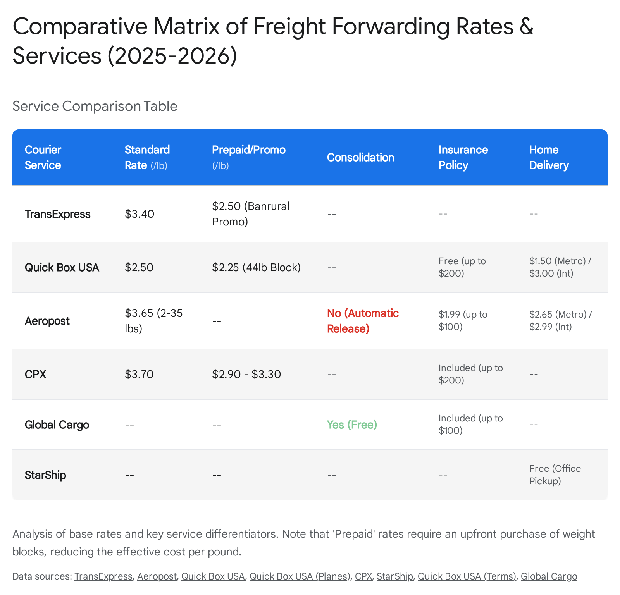
- The Speedrunner (Cost Efficiency): Quick Box USA is the recommendation for players prioritizing raw stat reduction. With a standard rate of $2.50/lb and a prepaid perk dropping to $2.25/lb, plus free metro delivery, it offers an immediate 25-35% gold saving. Warning: No consolidation support.
- The Inventory Manager (Consolidation): Global Cargo and StarShip are superior for “basket shoppers”—players ordering multiple small loot items. By offering free consolidation, these providers neutralize the “split shipment” penalty, potentially buffing your savings by 50%.
- The Tank (High Value): Aeropost remains the choice for high-stakes loot (laptops, GPUs). While expensive ($4.75 min), its “Aeroprotect” warranty acts as a critical shield against RNG (Random Number Generation) damage during transit.
Level 2: The Boss (TransExpress)
To optimize the new build, we must first audit the legacy provider. TransExpress has long been the formidable boss of the sector, but its legacy code is becoming a burden for the agile player.
2.1. Resource Drain Analysis
Current telemetry indicates a standard tariff of $3.40 USD per pound. While not the highest base stat, the perception of “expense” comes from the stacking of status effects (ancillary fees):
- Base Freight: $3.40/lb.
- Ancillary Fees: Customs processing (trámite de aduana), insurance, and repacking are billed as separate line items, bloating the final cost.
- Promotional Limitations: Seasonal buffs like the $2.50/lb (Banrural) or $1.99/lb (Black Friday) rates exist but come with “cooldowns” and strict covenants (e.g., specific bank cards, no returns). For the standard player, the high base rate applies.
2.2. Operational Constraints
- Volumetric Hitbox: TransExpress applies rigorous volumetric weight calculations, penalizing lightweight but bulky items (shoes, plushies).
- Customs Aggro: Strict adherence to protocols means even “de minimis” loot (under $300) is handled with rigid formality, often triggering processing fees even when duties are zero.
Level 3: Game Mechanics
Understanding the structural variables of the map is essential. The “cheapest” courier isn’t just about the rate card; it’s about aligning with the physics of the game.
3.1. The Volumetric Trap
Air freight is constrained by spatial dimensions, not just mass. The standard formula for volumetric weight determines your actual billing stat:

-
The Scenario: A pair of boots might weigh 3 lbs physically. However, the box dimensions:
 …result in a volumetric weight calculation of:
 lbs.
lbs. -
The Split: Legacy couriers apply this higher weight calculation strictly. New challengers like Quick Box USA often market “Real Weight” billing, absorbing the volumetric cost to capture market share.
3.2. Combo Breaker: Consolidation
This is the critical mechanic for Amazon players. Amazon’s logistics network favors speed, often splitting a single order into multiple packages (multi-hit combo).
- No Consolidation: Three packages at 0.2 lbs each are billed as 3 lbs total (1 lb min per package).
- With Consolidation: The courier buffers the packages, combines them, and bills for 1 lb total.
- Strategic Implication: A rate of $2.50/lb without consolidation is mathematically more expensive than $3.00/lb with consolidation for split shipments.
3.3. The $300 Shield (De Minimis)
El Salvador’s “Decreto IML4” provides a buff for players:
- The Rule: Personal loot under $300 USD (CIF) is typically exempt from DAI (Import Duties).
- The Nuance: IVA (13%) still applies. Informal “Encomendero” services often charge a flat rate that bypasses complex calculations, while formal couriers itemize every cent.
Level 4: Choose Your Fighter
4.1. Quick Box USA (The Speedrunner)
Built for players who want zero friction and low visible costs.
- Standard Rate: $2.50/lb. (26% savings vs TransExpress).
- Prepaid Buff: “Prepaid” blocks lower the rate to $2.25/lb.
- Perk: Real Weight Billing for standard parcels eliminates volumetric shock.
- Passive Ability: Free Metro Delivery (San Salvador, Santa Tecla, etc.).
- Critical Weakness: NO CONSOLIDATION. Every package is shipped immediately. Dangerous for fragmented Amazon orders.
4.2. StarShip & Global Cargo (The Inventory Managers)
The antidote to split shipments.
- Global Cargo: Offers Free Consolidation. You can buffer items until the full loadout arrives, saving massive gold on minimum weight fees. Includes insurance up to $100.
- StarShip: Massive agency network (Santa Tecla, San Miguel, Santa Ana, etc.). Best for players in the outer zones who need local pickup points. Features a “Tax-Free” Miami warehouse address (saves ~7% US Sales Tax).
4.3. Aeropost (The Tank)
The premium option for high-risk runs.
- Cost: High entry fee ($4.75 for 1st lb).
- Special Ability: All-In Calculator & Return Logistics. If your loot arrives damaged, they handle the return. Worth the premium for laptops/consoles.
Level 5: Simulation Results
To determine the true winner, we ran simulations on total landed costs.
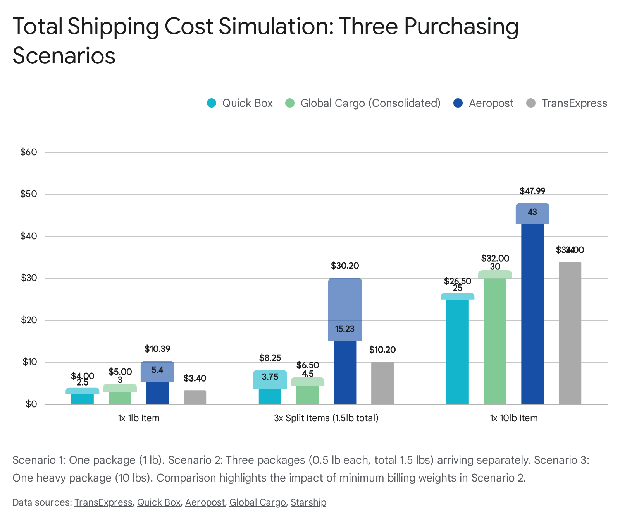
5.1. Scenario A: The Accessory (1 lb)
Loot: Phone case ($20).
- TransExpress: ~$5.40
- Quick Box USA: $2.50
- Winner: Quick Box USA. 50% savings.
5.2. Scenario B: The “Basket” (3 Items, Split)
Loot: 3 Cables ($10 each, shipped separately).
- Quick Box USA: 3 x $2.50 = $7.50 (No consolidation penalty)
- Global Cargo: Consolidated to 2 lbs = $5.00
- Winner: Global Cargo. Consolidation is the meta-breaker here.
5.3. Scenario C: Heavy Cargo (20 lbs)
Loot: Car Part ($150).
- TransExpress: $68.00
- Quick Box USA (Prepaid): $45.00
- Winner: Quick Box USA. Bulk discount yields massive savings.
End Game: Verdict
The “one-size-fits-all” strategy is obsolete. To min-max your logistics spend, you must adopt a multi-vendor loadout.
-
Primary Main (Standard Loot): Quick Box USA.
- Use for 80% of purchases (clothes, shoes, single gadgets).
- Action: Register and grab the Prepaid pack if volume > 10lbs/mo.
-
Secondary Support (Split Loot): Global Cargo / StarShip.
- Use specifically for “basket” orders where Amazon might split shipments.
- Action: Utilize Free Consolidation to avoid minimum weight penalties.
-
Specialist (High Tech): Aeropost.
- Use exclusively for high-value tech (Laptops, Cameras).
- Action: Pay the premium for the warranty shield.
Game Over.